Popular Categories
Popular Brands
Information
Ordering
|
|
|
|
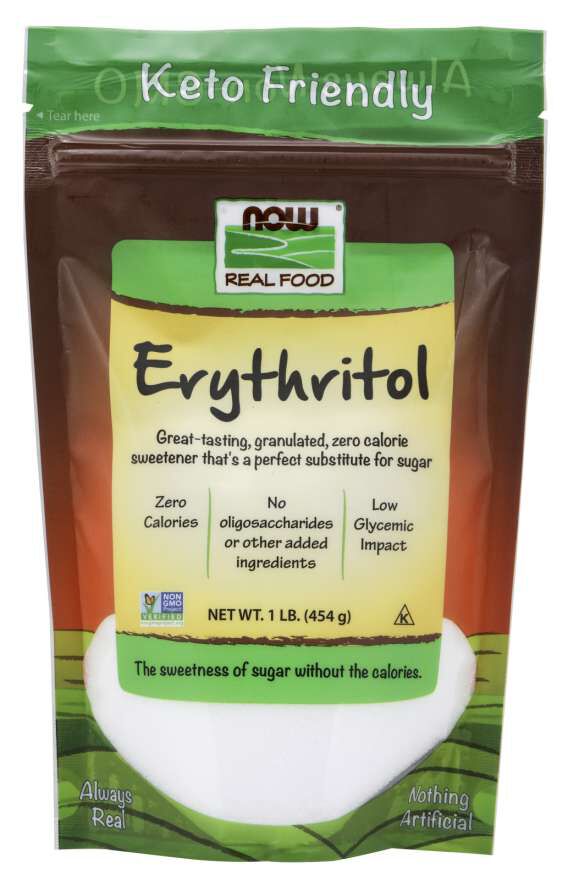
Erythritol Granular
Erythritol, a ployol (sugar alcohol), is a good-tasting sweetener which is
suitable for a variety of reduced-calorie and sugar-free foods. It can be used
as a sugar substitute in most sugar-free recipes. Erythritol has been part of
the human diet for thousands of years due to its presence in foods such as
pears, melons, grapes and mushrooms. NOW Erythritol is 100% pure and derived
from a corn source. Erythritol resembles sugar in consistency and taste but has
a caloric value near zero. It is also a great sugar alternative for diabetics.
Eyrthritol, like Xylitol, may also inhibit cavities by denying plaque bacteria
the fuel (sugar) it needs to erode tooth enamel.
- Low in calories: Erythritol has a very low caloric content;
its value is 0.2 calories per gram for food labeling purposes in
the United States and 0 (zero) calories per gram for food labeling
purposes in Japan. This very low calorie value is due to erythritol’s
unique absorption and elimination process which does not require the
metabolism of erythritol. Thus, erythritol is uniquely qualified as a
very low calorie bulk sweetener for formulating “light” and
“reduced calorie” products which require a 25% or more calorie
reduction from the standard formulation.
- High digestive tolerance: Erythritol is rapidly absorbed in
the small intestine due to its small molecular size and structure.
Several clinical studies conducted in Europe and Japan have shown
that more than 90% of ingested erythritol is absorbed and excreted
unchanged in urine within a 24-hour period. This digestive pathway
allows less than 5% of ingested erythritol to reach the large
intestine and be fermented into volatile fatty acids or metabolized
into carbon dioxide. As a result, foods containing substantial
amounts of erythritol are very unlikely to cause gaseous and
laxation side effects. A recent clinical study concluded daily
consumption of 1 gram per kilogram body weight is well tolerated
by adults as compared to sucrose containing foods.
- Safe for people with diabetes: Single dose and 14-day clinical
studies demonstrate erythritol does not affect blood serum glucose
or insulin levels. Clinical studies conducted in people with
diabetes conclude that erythritol may be safely used to replace
sucrose in foods formulated specifically for people with diabetes.
Of course, those with diabetes should consider the impact on their
diet of other ingredients used in foods sweetened with erythritol.
- Does not cause tooth decay: Erythritol like other polyols is
resistant to metabolism by oral bacteria which break down sugars
and starches to produce acids which may lead to tooth enamel loss
and cavities formation. They are, therefore, non-cariogenic. The
usefulness of polyols, including erythritol, as alternatives to
sugars and as part of a comprehensive program including proper
dental hygiene has been recognized by the American Dental Association.
The FDA has approved the use of a "does not promote tooth decay"
health claim in labeling for sugar-free foods that contain erythritol
or other polyols.
Add To Cart | Item ID | Product |
Unit Size |
List Price |
Our Price |
$200+ Orders
|
| Add |
153-0209 |
NOW
Erythritol Granular
|
1 lb. |
$8.99 |
$7.59 |
$7.21 |
All products are In Stock unless otherwise marked.
To place an order:
Add items to your Shopping Cart by clicking on "Add" above. Finished shopping? Checkout.
Display your Shopping Cart to view contents, shipping charges and options.
** The "$200+ Orders" price reflects a 5% discount for orders that total over $200.
|
|
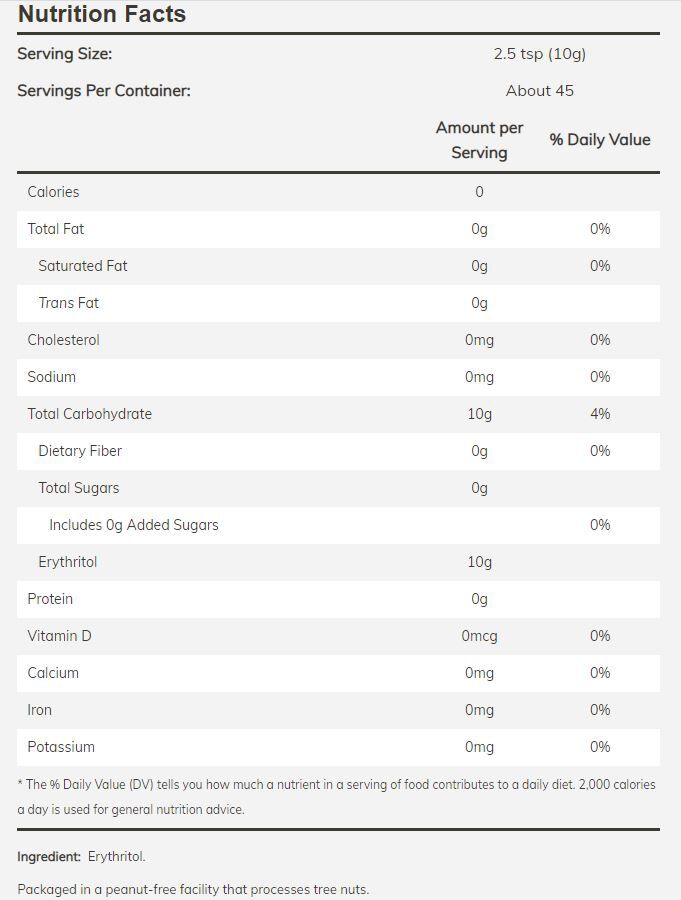
Nutrition Facts
Cart
Checkout
All NOW Products
|
|
|
Other products you may be interested in
Customer Reviews
Erythritol Granular (NOW) - Average rating (19 reviews)  -
Write a review
|
|
|
| 5 of 5 people found the following review helpful. |
October 05, 2007 Reviewer: Stephanie in Maryland |
| Oh, Erythritol. How do I love thee? Let me count the ways. 1. I love that non-dieters have no idea that you are not sugar.
2. I love that you maintain bulk in my baking recipes
3. I love that you mask the taste of other artificial sweeteners when I mix you with them
4. I love that you caramelize on the top of creme brulee
5. I love that you protect my teeth and gums
6. I love that you mix with chocolate in a way that Splenda never could
7. I love that you have almost no calories
8. I love that you don't cause gastric distress
9. I love the full bodied flavor you give to simple things like kool-aid
10. I love that you even look just like Sugar Only two things I do not love: 1. Your price tag!
2. The cooling effect that occurs in some baked goods unless I mix you with some other sweetener. |
| Was this review helpful to you? Yes  No |
|
| 1 of 1 people found the following review helpful. |
December 17, 2007 Reviewer: Donna H in Ohio |
| This is a bit pricey, but worth the cost compared to Splenda or sugar alcohols. My blood sugar levels don't go up with this product. When mixed with Stevia, this is a great substitute in all my recipes--my high-carb kids gobble up treats made with this stuff. |
| Was this review helpful to you? Yes  No |
|
September 28, 2009 Reviewer: val in Maine |
| I went low carb a few years ago and found several products to make it easy...except sweeteners. I can deal with the aftertaste, but there is one with Splenda. I was thrilled to try this this time around. I read the other reviews, and jumped in both feet. They are right, it has a literal cool feeling. But when used in conjunction with Splenda..woohoo..sweet, no aftertaste(surprised my family)and no coolness if you don't over do. I made PB cookies today and found I can back off on both sweeteners. I love it, and ordered two bags this time. |
| Was this review helpful to you? Yes  No |
|
August 26, 2009 Reviewer: Laurie in New York |
| I use a lot of different sugar substitutes when baking, as I follow the South Beach Diet. Erythritol is one of my favorites because it has the weight and texture of sugar. When creaming butter with sugar in baking, the texture of the sugar crystals is very important. If you use a sugar substitute such as Splenda in recipes that call for creaming, it doesn't work nearly as well as with the real thing, but with erythritol, you get great results. Because it has a laxative effect, I only use a small amount in my recipes, combining it with other substitutes, such as Splenda, Stevia (especially NuStevia's More Fiber), and agave nectar. It's an indispensable part of my pantry. |
| Was this review helpful to you? Yes  No |
|
January 31, 2009 Reviewer: James in North Carolina |
| Erythritol is great! Looks, tastes, and behaves just like sugar and does not cause gas as other sugar alcohols can do. |
| Was this review helpful to you? Yes  No |
|
See more reviews
|
|
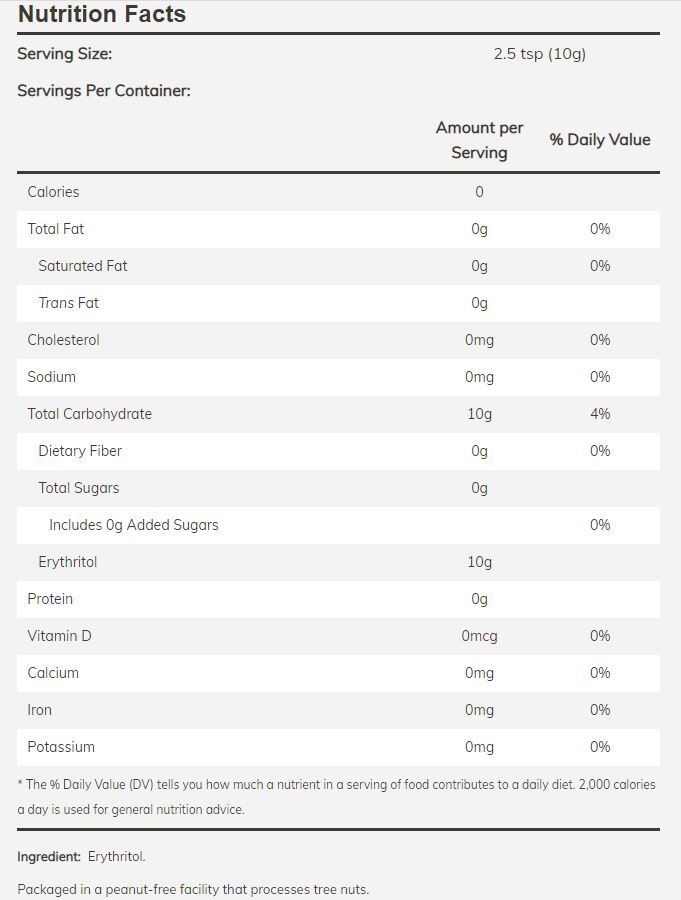
Nutrition Facts
153-0209 NOW Erythritol Granular 1 lb.
|
|
Erythritol, a polyol (sugar alcohol), is a good-tasting bulk
sweetener which is suitable for a
variety of reduced- calorie and sugar-free foods. It has been part
of the human diet for thousands of years due to its presence in fruits
and other foods
such as pears,
melons and grapes, as well as foods such as mushrooms and
fermentation-derived foods such as wine, soy sauce and cheese.
Erythritol has a high digestive tolerance (unlike Maltitol's
laxative effects), is safe for people with diabetes, and does not promote tooth decay.
Erythritol, because it is such a small molecule behaves differently from
all other polyols in the way it passes through the human digestive system,
and therefore has a unique metabolic profile.
The low molecular weight allows more than 90% of the ingested erythritol
to be rapidly absorbed from the small intestine. It is not metabolized
and is excreted unchanged in the urine.
Since 1990, erythritol has been commercially produced and added
to foods and beverages to provide sweetness, as well as enhance
their taste and texture.
Erythritol is a white crystalline powder that is odorless, with a clean
sweet taste that is similar to sucrose. It is approximately 70% as
sweet as sucrose and flows easily due to its non-hygroscopic character.
Like other polyols, erythritol does not promote tooth decay and is
safe for people with diabetes. However, erythritol’s caloric value
of 0.2 calories per gram and high digestive tolerance distinguishes
it from some other polyols. It has approximately 7 to 13% the calories
of other polyols and 5% the calories of sucrose. Because erythritol is
rapidly absorbed in the small intestine and rapidly eliminated by the
body within 24 hours, laxative side effects sometimes associated with
excessive polyol consumption are unlikely when consuming erythritol
containing foods.
Examples of energy values (calories) for polyols (sugar alcohols) in various countries/areas (Kcal/g)
|
|
Sorbitol
|
Mannitol
|
Maltitol
|
Isomalt
|
Xylitol
|
Erythritol
|
|
Japan
|
3.0
|
2.0
|
2.0
|
2.0
|
3.0
|
0.0
|
|
USA
|
2.6
|
1.6
|
3.0
|
2.0
|
2.4
|
0.2
|
|
Canada
|
2.6
|
1.6
|
3.0
|
2.0
|
3.0
|
|
|
ANZ *
|
3.3
|
2.1
|
3.8
|
2.9
|
3.3
|
0.2
|
|
EU
|
2.4
|
2.4
|
2.4
|
2.4
|
2.4
|
|
| * Australia and New Zealand |
|
A GRAS (Generally Recognized As Safe) affirmation petition submitted
by a consortium of erythritol manufacturers (Cerestar Holding B.V.,
Mitsubishi Chemical Corporation and Nikken Chemicals Co.) was accepted
for filing by the U.S. Food and Drug Administration on January 15, 1997.
This allows manufacturers to produce and sell erythritol containing foods
in the United States. Erythritol is regulated as a direct food ingredient
in Japan and since 1990 it has been used in many Japanese food categories.
Safety
The safety of erythritol as a food ingredient under conditions of its intended use is
substantiated by a number of human and animal safety studies, including short- and long-
term feeding, multi-generation reproduction and teratology studies.
The U.S. GRAS affirmation petition states erythritol is intended for use as flavor enhancer,
formulation aid, humectant, nutritive sweetener, stabilizer and thickener, suquestrant and
texturizer. The petition lists maximum erythritol use levels of 100% in sugar substitutes,
50% in hard candies, 40% in soft candies, 1.5% in reduced and low calorie beverages, 60% in
fat based creams for cookies, cakes and pastries, 7% in dietetic cookies and wafers, and 60%
in chewing gum.
Erythritol has been used in Japan since 1990 in candies, chocolates, soft drinks, chewing gums,
yogurts, fillings, cookie coatings, jellies, jams and sugar substitutes. Petitions have been
submitted to additional governmental agencies throughout the world to expand the use of erythritol.
Multiple Ingredient Approach to Calorie Control -
Erythritol blends well with other polyols and flavors and can mask off-flavors such as bitterness
sometimes associated with other low-calorie sweeteners. Erythritol is synergistic with low-calorie
sweeteners such as aspartame and acesulfame potassium, resulting in a sweetener combination which
is sweeter than the sum of the individual components and with an improved taste profile with superior
taste, economic and stability advantages.
|
|
|